Nyungwe Forest National Park is Rwanda’s chimpanzee trekking destination and its largest protected rainforest, covering close to 1,000 square kilometres across the southwest, from the Burundi border up towards Lake Kivu. Visitors book chimpanzee trekking safaris, colobus monkey tracking, the suspended canopy walkway and long forest hikes. It became a national park in 2005 and was inscribed as a UNESCO World Heritage Site in 2023, the first site in Rwanda to earn that listing.
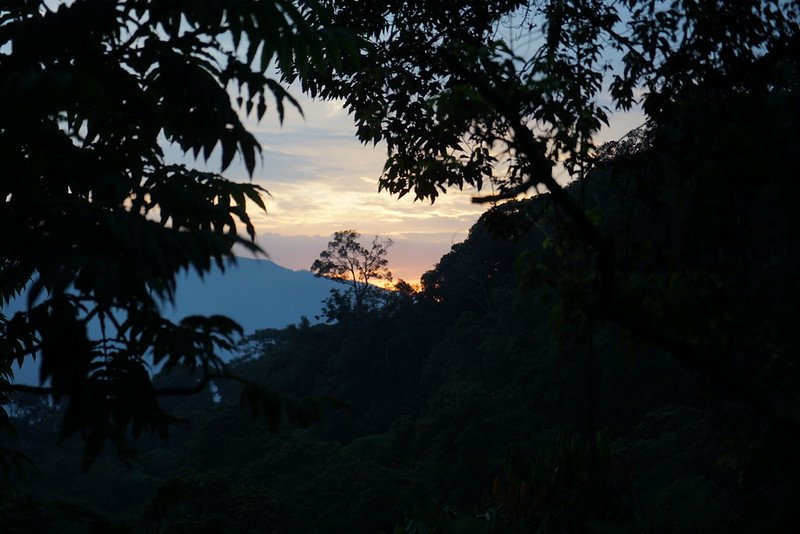
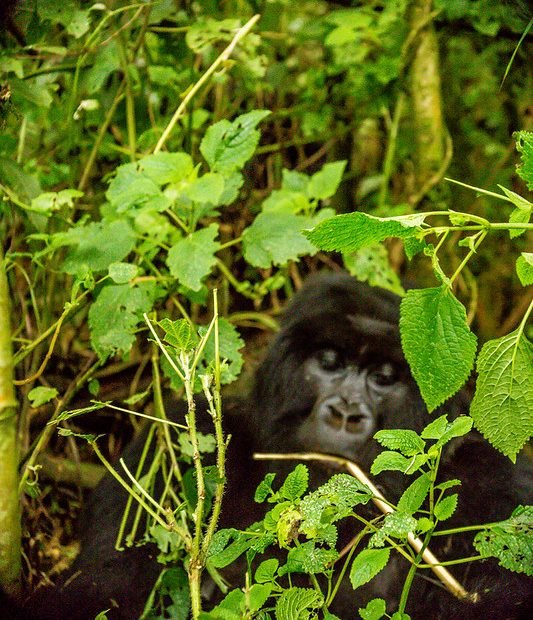
This is old forest, protected as a reserve since 1903 and never cleared to the ground. It sits on the ridge that divides the Congo and Nile watersheds, which is why the water running off these slopes ends up in two different oceans. Thirteen primate species live here, along with more than 300 birds, around 1,000 plant species and a butterfly list that runs past 100. Nobody comes to Nyungwe for big game. They come because the forest itself is the attraction.
Chimpanzee Trekking Safaris in Nyungwe Forest
A chimpanzee trekking safari in Nyungwe is the park’s signature activity, and it demands an early start that catches people out. Briefing is often at five in the morning, sometimes earlier, because chimps are loudest and most locatable at first light before they scatter to feed.
Two main communities are visited. One lives in Cyamudongo, a separated block of forest to the west that holds a smaller group of around thirty animals, and the other ranges near Uwinka in the main forest. Trackers locate the nests overnight or at dawn and guide groups in from there. Cyamudongo tends to give closer and more reliable sightings, though it means a longer drive from most lodges.
Set your expectations properly, because this is where Nyungwe disappoints people who arrived thinking it works like gorilla trekking. Chimps are semi habituated rather than fully habituated. They move fast, often high in the canopy, and a good morning can mean twenty minutes of hearing pant hoots and craning upward at a fig tree rather than an hour sitting quietly at ground level. Some treks produce nothing at all. Guides say this plainly at the briefing and it is the honest position.
When it works, it is worth every bit of the early alarm. A community calling to each other across a valley at dawn, then crashing down through the branches thirty metres away, is a different kind of forest experience from anything the Virungas offer. The terrain is steep and slick with leaf litter, and hiring a porter at the trailhead makes both the descent and the climb back out considerably easier.
Chimps in Nyungwe often feed lower and closer to the trails during the rainy months, when fruiting patterns change. That makes March to May and October to November genuinely good for a chimpanzee trek, which runs against the usual dry season advice for Rwanda.
Safari packages visiting Nyungwe Forest National Park
6 Day Rwanda Gorillas And Chimpanzees Safari
Six days tracking chimpanzees in Nyungwe Forest and mountain gorillas at Volcanoes National Park, with two nights on Lake Kivu between them.…
Rwanda · Nyungwe Forest, Lake Kivu, Volcanoes National Park, Nyanza & Huye
View itinerary 6 Day Rwanda Gorillas And Chimpanzees Safari
7 Day Rwanda Primates And Big Five Safari
Seven days across three Rwandan national parks: chimpanzees in Nyungwe, mountain gorillas at Volcanoes and Big Five game drives with a Lake…
Rwanda · Nyungwe Forest, Lake Kivu, Volcanoes National Park, Akagera & Kigali
View itinerary 7 Day Rwanda Primates And Big Five Safari
8 Day Four Parks Of Rwanda Safari
Eight days covering all four Rwandan national parks: Akagera Big Five, gorillas at Volcanoes, restored forest at Gishwati Mukura and chimpanzees in…
Rwanda · Akagera, Volcanoes, Gishwati Mukura & Nyungwe National Parks
View itinerary 8 Day Four Parks Of Rwanda Safari
8 Day Rwanda Hiking And Gorilla Trekking Safari
Eight days walking Rwanda: Mount Bigugu and the Nyungwe trails, a Congo Nile Trail section on Lake Kivu, Mount Bisoke, the Dian…
Rwanda · Nyungwe Forest, Lake Kivu, Musanze & Volcanoes National Park
View itinerary 8 Day Rwanda Hiking And Gorilla Trekking Safari
10 Day Best Of Rwanda Safari
Ten days across Rwanda at a sensible pace: Kigali, Big Five in Akagera, gorillas and golden monkeys at Volcanoes, Lake Kivu and…
Rwanda · Kigali, Akagera, Volcanoes National Park, Lake Kivu & Nyungwe Forest
View itinerary 10 Day Best Of Rwanda Safari
10 Day Rwanda Birding And Gorilla Trekking Safari
Ten days birding Rwanda: Nyandungu and the Bugesera wetlands, Akagera papyrus, Rugezi Marsh, the Virunga bamboo, Gishwati and Nyungwe, with a gorilla…
Rwanda · Kigali, Bugesera, Akagera, Rugezi Marsh, Volcanoes, Gishwati Mukura & Nyungwe
View itinerary 10 Day Rwanda Birding And Gorilla Trekking SafariColobus Monkey Tracking Tours at Gisakura and Uwinka
Colobus monkey tracking is the park’s most underrated half day and its most reliable primate activity. Nyungwe holds the largest known troops of Rwenzori colobus in Africa, with groups of 300 or more animals moving together, which is very unusual behaviour for a colobus species.
Tracking starts from either the Gisakura visitor centre on the western edge, next to the tea estate, or from Uwinka in the middle of the park. Gisakura sessions are the easier walk, since the troop often ranges along the forest margin near the plantation rather than deep inside. Sessions run at several points through the day rather than only at dawn, which makes it a good afternoon activity after a morning trek.
Watching several hundred black and white monkeys pour through a stretch of canopy, tails hanging like ropes, is the sort of thing people remember more clearly than they expected to. The walking is modest, the sightings are close to dependable, and it suits families and anyone who found the chimp trek hard going.
The Nyungwe Canopy Walkway Tour on the Igishigishigi Trail
The canopy walkway tour is the reason a lot of visitors come to Nyungwe at all, and it delivers. The suspended bridge runs roughly 160 metres between towers anchored in tall trees, hanging around 60 to 70 metres above the forest floor. It was the first structure of its kind in East Africa.
Access is on the Igishigishigi trail from the Uwinka visitor centre, a walk of about 2.1 kilometres past giant tree ferns, and the full round trip takes roughly two hours. All walks are guided; you cannot go out on the bridge alone. Departures run through the day, commonly around eight, ten, midday and mid afternoon, and booking ahead matters in the busy months.
The bridge moves. It is safe and well maintained, though anyone with a real fear of heights should think about it honestly before paying, because the middle span flexes underfoot and there is a long way down through the mesh. From up there you look across an unbroken canopy running to the horizon, and you see the forest as a single connected thing rather than as a series of trails.
Rain here is not a seasonal event. Nyungwe takes around 2,000 millimetres a year, which is exactly why the forest looks the way it does. Pack for wet regardless of the month.
Hiking Trails and Waterfall Treks in Nyungwe Forest
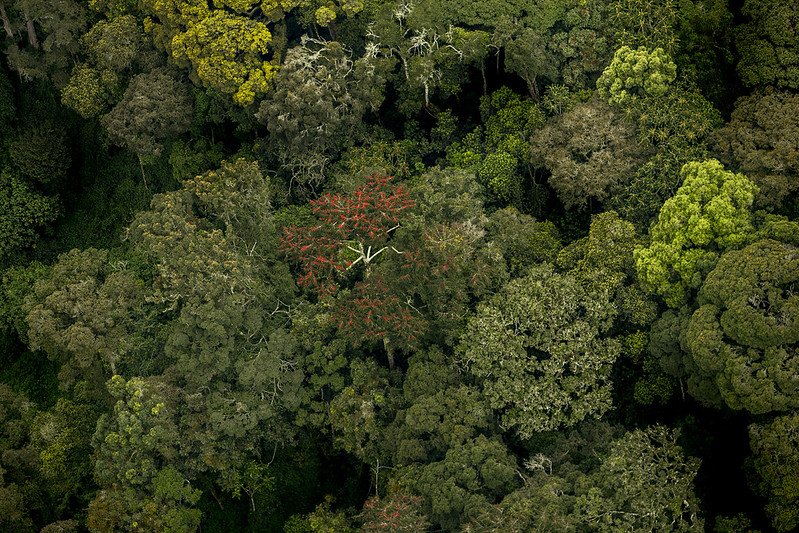
Nyungwe has over 130 kilometres of maintained trail, more than a dozen named routes, and it is the best hiking park in Rwanda by a distance. Trails start from three reception centres: Kitabi at the eastern entrance, Uwinka in the centre and Gisakura on the western side.
Igishigishigi Trail. Around 2.1 kilometres, roughly an hour and a half, easy. The canopy walkway route, and the busiest path in the park. Good for first time hikers and shorter on effort than the distance suggests.
Kamiranzovu Trail. About six kilometres, three hours or so, moderate. Runs down to the Kamiranzovu swamp, the largest wetland in the park and a major peat bog, with a waterfall on the route and orchids through the marsh margins.
Isumo Waterfall Trail. Roughly ten kilometres from Gisakura, about four hours, moderate with a steep section. Cuts through the tea estate before dropping into forest to reach the park’s biggest waterfall. Colobus and blue monkeys are common along the edges.
Bigugu Trail. Around 13 kilometres, six hours, difficult. The climb to Bigugu peak, the highest point in the park, with views out over Lake Kivu and into the Congo on a clear day. Serious walkers only.
Imbaraga and Umuyove Trails. Imbaraga passes four waterfalls over a long loop. Umuyove runs through stands of huge hardwood and medicinal plants. Both start from Uwinka and suit walkers who want forest rather than a summit.
Congo Nile Divide Trail. A multi day route of over 40 kilometres, usually done across three nights and mostly by cyclists. It follows the watershed ridge and ends beyond the park boundary.
Trails are graded and guides are assigned at the reception centres. Boots with grip matter more than anything else in your bag, since the volcanic and forest soils here stay greasy for days after rain.
Birding Safaris and Albertine Rift Endemics in Nyungwe
Birding safaris in Nyungwe put it among the better forest birding sites on the continent. Something close to 300 species have been recorded, and somewhere between 25 and 30 of them are Albertine Rift endemics found in a narrow strip of Africa and nowhere else.
The list birders travel for includes the Rwenzori turaco, great blue turaco, red collared babbler, Grauer’s warbler, handsome francolin, Rwenzori nightjar, Albertine owlet and a range of sunbirds. The red collared babbler in particular draws people from a long way, since Nyungwe is one of the few reliable places to look for it.
Karamba trail near Gisakura is the classic birding walk, running through an old gold mining and army camp site that has grown back into secondary bush and holds a different mix from the deep forest. Kamiranzovu is the wetland option. Take a specialist birding guide rather than a general trail guide, because the difference in what gets found is large.
Ziplining and Forest Adventure Tours at Uwinka
A zipline adventure now runs from Uwinka across the valley, built in three linked sections totalling around 1,850 metres, at heights of roughly 20 to 50 metres above the forest floor. Each section is named after one of the park’s primates, and the final run drops you near the canopy walkway connection.
It is the longest zipline in East Africa at present and it is aimed squarely at people who want something other than a slow trail walk. Departures run through the middle of the day, with the last group usually setting off in mid afternoon.
A rope course sits alongside it at Uwinka, with hanging tyres, nets and swinging logs strung between trees at height. Both work well as a second day activity for families, or for anyone who has done the chimp trek and wants a lighter afternoon that is still spent up in the canopy.
Gisakura and Gisovu Tea Estate Tours on the Forest Edge
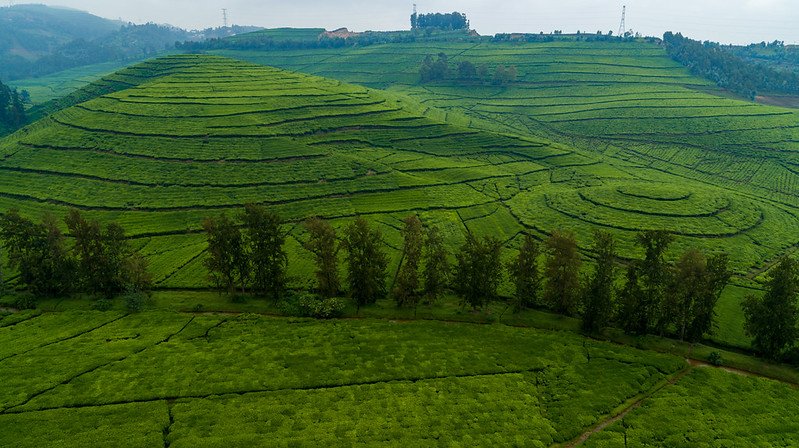
The western boundary of Nyungwe runs straight into tea. The Gisakura estate covers roughly 1,600 hectares and acts as a buffer between the forest and the farmland beyond it, and a tea estate tour here is one of the easiest and most photogenic mornings available.
Pickers work Monday through Saturday, moving along the contour rows with baskets on their backs, and most are happy to stop and talk. Guided visits cover how the leaf is picked, graded and processed, and the factory tours explain why altitude gives Rwandan tea its particular character. Gisovu estate on the northern side offers a similar visit with a guesthouse attached.
Coffee is grown on these slopes too, and the Uwinka, Gisakura and Gisovu reception centres all run coffee shops serving beans grown nearby, which is a better cup than you would expect from a park visitor centre.
Best Time for a Nyungwe Forest Safari
Temperatures barely move here, sitting around twenty degrees by day and dropping to about ten at night through the year. What changes is rainfall, and the honest position is that this is a rainforest and it rains in every month.
June to September. The long dry season. Firmest trails, best conditions for the hard hikes like Bigugu, and the busiest period. Chimps range more widely when fruit is scattered, so treks can be longer.
Mid December to February. The short dry season. Similar walking conditions with fewer people on the canopy walkway. A good window if you want both reasonable weather and space.
March to May. Long rains, and the strongest months for chimpanzee trekking, mud and all, because the apes tend to feed lower and closer to the trails. Waterfalls run at full strength. Hiking gets slow and slippery.
October and November. Short rains, with migrant birds arriving from November onwards. A strong choice for birding safaris, and quieter across the whole park.
Pack a waterproof jacket, quick drying layers, gaiters or long socks against safari ants on the forest floor, and boots you have already worn in. A dry bag for camera gear is worth the space.
Getting to Nyungwe Forest National Park from Kigali
Nyungwe is the longest road day in Rwanda, around 225 kilometres southwest of Kigali and roughly five to six hours to the Uwinka reception centre. The drive itself is good, running through terraced hills and tea country, and many people break it at Huye or come down the Lake Kivu shoreline instead and arrive from the north.
RwandAir flies from Kigali to Kamembe airport near Rusizi in around forty minutes, which puts you close to the western side of the park and cuts a long day to a short one. This is the sensible option for anyone with limited time or a low tolerance for winding roads.
Accommodation ranges from campsites and the Gisakura guesthouse near the park office up through Nyungwe Top View Hill Hotel to the high end lodges set in the tea. Where you sleep matters here more than in most parks, because a Cyamudongo chimp trek starting at five in the morning is a very different proposition from the western side than from the east.
Most people fold Nyungwe into a wider Rwanda circuit rather than visiting it alone, coming down from the volcanoes along Lake Kivu or looping back up towards Kigali afterwards. Intare Safaris builds those routes regularly and knows the details that decide whether a Nyungwe leg works: which reception centre suits your trek, how the road is holding up in a wet month, and whether the flight to Kamembe is worth it for your dates.
Drop Intare Safaris a message with your dates and how much walking you are up for, and they will tell you straight whether Nyungwe belongs in your trip and how many nights it actually needs.