Rwanda coffee tours take visitors onto smallholder farms and into washing stations to follow the arabica crop from cherry to cup, usually finishing with a cupping session. The best known destinations are Kinunu on the Lake Kivu shore, Huye Mountain in the south, the Ingoboka collective near Kayove and women led cooperatives near Kigali. Rwanda grows almost entirely bourbon arabica at altitudes between roughly 1,200 and 2,000 metres, farmed by around 400,000 smallholders.
This is one of the more underrated half days in the country. It costs little time, it fits neatly around gorilla trekking or a Kivu stay, and it takes you into working agriculture rather than a demonstration set up for visitors. If you drink coffee at all, it changes how you think about the cup.
Safaris built around culture and history

What a Rwanda Coffee Tour Involves
A typical coffee tour runs between one and a half and three hours, depending on whether you walk the farms too or only the station.
You start in the field, among trees planted on steep terraced slopes, often intercropped with bananas and beans because families need to eat, not just to sell. A farmer will show you how cherries ripen, which ones get picked and which get left, and how the plots are managed through the year. The trees are small in number: the average Rwandan coffee farmer works a few hundred trees on a fraction of a hectare, which is tiny by global standards and shapes everything about how the industry runs.
From there you move to the washing station, where the processing happens and where most of the interest lies. Sorting, pulping, fermentation, grading, drying. Then the tasting, which is usually a proper cupping rather than a cup of coffee handed over at the end.
Many stations also let visitors take part rather than only watch, particularly during harvest, when there is always sorting to be done and an extra pair of hands is genuinely useful.
The harvest runs roughly March to June, with processing continuing into July, and a smaller secondary harvest around September to November. Outside those months you can still tour a station and see the equipment and the drying beds, but there will be no cherries and no activity. If seeing the work matters to you, time the visit.
Kinunu Coffee Washing Station on Lake Kivu
Kinunu is the most visited coffee destination in Rwanda and the setting explains a good part of why. The station sits directly above Lake Kivu, roughly twenty kilometres south of Rubavu, with drying beds facing out across the water towards the Congo hills.
It buys cherries from hundreds of smallholders living around the station, most farming plots smaller than a quarter of a hectare, and works with several local cooperatives and farmers’ associations. Guides walk you through the fields first, then into the processing.
What makes Kinunu worth the trip is how much is still done by hand. Cherries are hand sorted so only ripe red fruit goes forward. Wet sorting on the raised screens is largely done by women, working along the beds turning and picking out defects. The tasting at the end uses beans processed on the spot.
Access is part of the appeal. Kinunu can be reached by road, by bicycle along the Congo Nile Trail or by boat across the lake, which means the visit can be built into a cycling day or a boat trip rather than being a separate excursion.
Huye Mountain Coffee Tours in Southern Rwanda
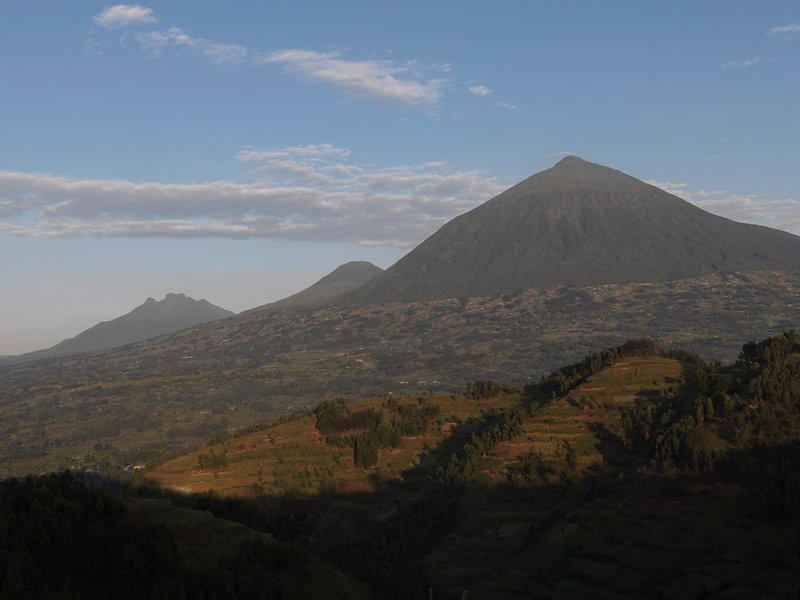
Huye Mountain, in the southern district of the same name, is the best known coffee destination away from Lake Kivu and runs a more agricultural visit than Kinunu.
The operation works with over a thousand farmers delivering cherries to a network of collecting stations, and it was set up to give smallholders direct access to specialty buyers rather than selling into the commodity market. Farmers are organised into savings and lending groups alongside the coffee work, which is a substantial part of what the visit covers.
Tours follow the full sequence from growing and harvesting through drying, roasting, grinding and packing, and there is a hike up the mountain itself for anyone who wants the view over the plantations. Roasted beans and handicrafts are sold at the end.
Huye sits on the southern road between Kigali and Nyungwe Forest, close to the Ethnographic Museum and not far from the King’s Palace at Nyanza, so it slots neatly into a day that already has other stops in it.
Women Led Cooperatives and Question Coffee
Some of the most interesting coffee visits in Rwanda are built around women’s cooperatives, and this is more than a marketing angle. Coffee has become one of the main routes to independent income for rural women here, and several operations are wholly women owned and run.
Question Coffee in Kigali works in partnership with women’s cooperatives across the country and runs both a café and a training programme. Their farm tours take visitors out to a plantation where farmers explain planting, nurturing saplings and maintaining productive trees, then on to the washing station that serves the sector, before returning for a cupping session in the city.
Farmers often greet visiting groups with a welcome song about coffee growing, which sounds staged in the description and is not in practice.
For anyone with only a day in Kigali and no time to reach Kivu or Huye, this is the coffee experience to book. It covers the whole chain, it is reachable from the capital, and the money goes where the story says it does.
Coffee Tours Around Lake Kivu and Nyamirundi Island
The Kivu shore is Rwanda’s densest coffee country and holds more washing stations than most visitors realise.
Ingoboka collective, near Kayove. Runs several plantations and washing stations between Rubavu and Karongi, including a cluster of farms on Nyamirundi Island reached by a short paddle from the mainland. A coffee visit that involves a boat crossing is a good day out by any measure.
Northern shore stations. A number of washing stations operate around Rubavu and the hills behind it, sourcing from island and mainland cooperatives. Several can be visited by arrangement rather than on a fixed schedule.
Karongi and the southern shore. Stations south of Karongi work the middle stretch of the lake, and coffee grows right down to the Nyamasheke district near Nyungwe, where several farms sit within reach of the forest lodges.
Gisovu and Gisakura. Best known for tea rather than coffee, these estates on the Nyungwe boundary produce both and make a good pairing if you want to see the two crops in one trip.
Rwanda’s Coffee Story: Bourbon Arabica and Smallholders
Coffee arrived in Rwanda with German missionaries in the early years of the twentieth century, and for most of the following century it was grown as a low value commodity crop, sold unprocessed and largely undifferentiated.
What changed was a deliberate shift towards quality. Washing stations were built in numbers, farmers were trained, and the country moved from selling bulk semi washed coffee to selling traceable specialty lots. Rwanda held its first Cup of Excellence competition in 2008 and has run it annually since, which put individual Rwandan lots in front of international buyers for the first time.
Almost all Rwandan coffee is arabica, and the great majority of that is bourbon, mostly red bourbon and yellow bourbon, with small amounts of mayaguez cultivars, catuai and caturra. Trees flower around September and October, and the cherries are harvested from March through to June or July.
The combination of volcanic soil, altitude and slow ripening gives Rwandan coffee its recognisable character: bright citric acidity, a clean cup and notes that buyers describe as orange peel, brown sugar and floral.
The average Rwandan coffee farmer works a few hundred trees on half a hectare. Every specialty lot leaving this country is the combined work of hundreds of families delivering cherries to one station.
From Cherry to Cup: The Washing Station Process
The washing station is where a coffee tour becomes genuinely interesting, and knowing the sequence in advance makes the visit far better.
Cherries arrive from farmers and are hand sorted so only ripe red fruit continues. They are then pulped the same day, usually in the evening, on a mechanical pulper that separates the beans into grades. The pulped coffee ferments overnight, commonly around twelve hours, which breaks down the sticky mucilage still clinging to the parchment.
Next comes flotation grading in water channels, which sorts by density, since heavier beans tend to be the better ones. The coffee is then soaked for a further period before being moved to raised drying screens, the African beds, where it dries in the sun over days with constant hand sorting to pull out defects.
Once moisture drops to around eleven percent the parchment coffee goes to a dry mill, usually in Kigali, for hulling, grading and cupping by a qualified taster before export.
One honest thing that most tours will tell you and most marketing will not: Rwanda has a long standing problem with the potato defect, a bacterial issue that gives an occasional cup an unmistakable raw potato taste. There is no mechanical way to identify affected beans, so even excellent lots throw one now and then. Anyone who tastes it should know it is a known quirk of the region rather than bad coffee.
Cupping Sessions and Kigali’s Coffee Shops
A cupping is a formal tasting, and most good coffee tours end with one. Ground coffee is steeped in hot water in a line of bowls, the crust is broken and the aroma taken, then samples are slurped from a spoon so the liquid aerates across the palate.
It feels ridiculous the first time and then it works. Differences between lots that seemed indistinguishable in a cup become obvious side by side, and the vocabulary buyers use stops sounding like invention.
In Kigali the café scene has grown quickly, which is a recent development in a country that exported nearly all its coffee for decades while locals drank tea. Question Coffee runs cupping sessions and barista training. Bourbon Coffee serves single origin pour overs across several branches. Kivu Noir works a more modern room and pairs coffee with food. Many roast on site, so asking for something roasted that week is a reasonable request.
Beans are the best souvenir to take home from Rwanda, and buying at the washing station or from a Kigali roaster puts more of the money where it belongs than buying at the airport.
Best Time for a Rwanda Coffee Tour
Stations are open year round, but what you actually see varies enormously with the season.
March to June, main harvest. The best window by a distance. Red cherries on the trees, pickers working the slopes, pulping running in the evenings and the drying beds full. This overlaps with the long rains, so pair it with chimpanzee trekking, which is also strong in these months.
July. Processing continues after picking finishes, so the stations remain active on the drying and sorting side even as the fields quieten. A good compromise if you also want dry season trekking.
September to November. Trees flower around September and October, which is worth seeing in itself, and a smaller secondary harvest runs through this period at some stations.
December to February. The quietest months on the farms. Tours still run and the tasting is unaffected, but you will be shown equipment rather than watching it work. Fine if coffee is a side interest rather than the reason you came.
Planning Coffee Tours Into a Rwanda Itinerary
Coffee tours are easy to fit because the growing regions sit along routes people already travel. Kinunu and the Kivu stations are on the western shore between Volcanoes National Park and Nyungwe. Huye is on the southern road. The Kigali cooperatives need only a morning from the capital.
The pattern that works well gives a coffee morning during a Lake Kivu stay, when the pace has already slowed and nobody minds a late start. A second option is Huye on the drive south to Nyungwe, which breaks a long road day usefully.
Practical notes: wear shoes you can walk terraced slopes in, since farm visits involve real gradients. Carry local currency for buying beans, as card payment at rural stations is not dependable. And book ahead rather than arriving unannounced, because these are working operations and someone has to be freed up to guide you.
Coffee visits are also among the easiest activities to get wrong, since a poorly arranged one is a walk past some equipment and a cup of instant. Intare Safaris is Rwandan, knows which stations are genuinely worth the drive in which month, and can arrange a visit that includes the farm, the processing and a proper cupping rather than a token stop.
Mention to Intare Safaris that you want a coffee morning when you enquire, and they will place it in the right region for your route and the right month for the harvest.