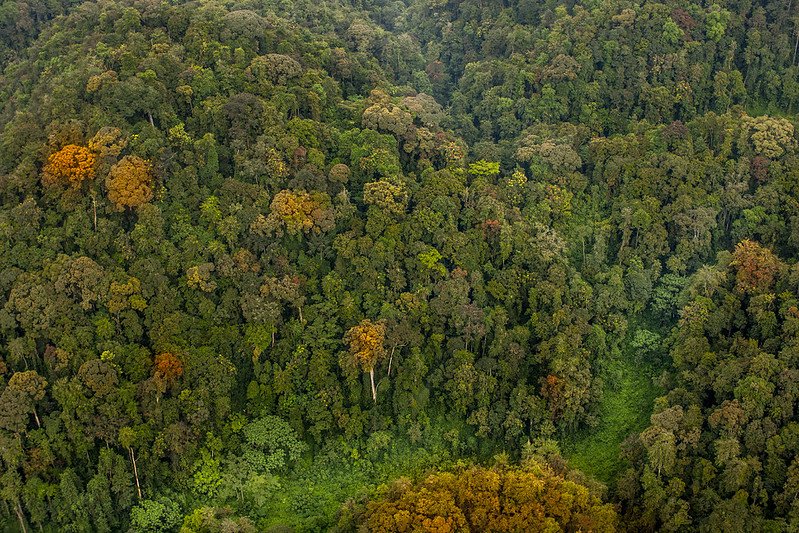
Gishwati Mukura National Park is Rwanda’s fourth and smallest national park, covering roughly 34 square kilometres across two separate forest blocks on the ridge above Lake Kivu. Visitors book guided chimpanzee tracking safaris, golden monkey trekking, waterfall hikes and birding tours, all run from a single community guesthouse. Gazetted in 2015 and named a UNESCO Biosphere Reserve in 2020, it protects what is left of a forest that was almost entirely cleared within living memory.
That last point matters more here than at any other Rwandan park. Gishwati once ran to hundreds of square kilometres. By the mid 1990s, after decades of settlement, cattle ranching, illegal mining and logging, it had been reduced to a few hundred hectares of fragmented woodland with a stranded chimpanzee community inside it. What you walk through today is forest that has been deliberately grown back, and it is one of the few places in Africa where you can see restoration happening at close range rather than read about it.
Chimpanzee Tracking Safaris in Gishwati Forest
Chimpanzee tracking is the headline activity, and Gishwati asks you to arrive with realistic expectations. The forest holds a community of somewhere between twenty and thirty eastern chimpanzees, animals that survived the clearance by retreating into the last standing patches.
These chimps are not habituated in the way Nyungwe’s communities are. They have had far less contact with people and they are wary. A guided track can turn up nothing at all, and even when the group is located, getting close is difficult and the animals may move off quickly. Any operator who tells you otherwise is not being straight with you.
The way to improve your odds is to go out before dawn to where the chimps nested the previous evening, then wait. Watching a community wake, stretch, call across the canopy and drop down to start the day is a slower and more patient thing than a standard trek, and people who get it usually rate it above a busier sighting elsewhere. Guides here know the animals individually because they work with a small population in a small forest.
Nobody should choose Gishwati over Nyungwe for a first chimpanzee trek. As a second primate site on a longer Rwanda tour, or for travellers who value quiet and a real conservation story over a guaranteed photograph, it makes complete sense.
Safari packages visiting Gishwati Mukura National Park
8 Day Four Parks Of Rwanda Safari
Eight days covering all four Rwandan national parks: Akagera Big Five, gorillas at Volcanoes, restored forest at Gishwati Mukura and chimpanzees in…
Rwanda · Akagera, Volcanoes, Gishwati Mukura & Nyungwe National Parks
View itinerary 8 Day Four Parks Of Rwanda Safari
10 Day Rwanda Birding And Gorilla Trekking Safari
Ten days birding Rwanda: Nyandungu and the Bugesera wetlands, Akagera papyrus, Rugezi Marsh, the Virunga bamboo, Gishwati and Nyungwe, with a gorilla…
Rwanda · Kigali, Bugesera, Akagera, Rugezi Marsh, Volcanoes, Gishwati Mukura & Nyungwe
View itinerary 10 Day Rwanda Birding And Gorilla Trekking Safari
12 Day Rwanda In Depth Safari
Twelve days across every Rwandan national park, with two gorilla permits, chimpanzees at Nyungwe, Big Five in Akagera, Lake Kivu, Gishwati Mukura…
Rwanda · Kigali, Akagera, Volcanoes, Lake Kivu, Gishwati Mukura & Nyungwe Forest
View itinerary 12 Day Rwanda In Depth SafariGolden Monkey and Primate Tracking Tours in Gishwati
Golden monkey tracking runs here as well, and it is a rarer thing than it sounds. Golden monkeys are found only along the Albertine Rift, mainly in the Virunga bamboo, and the Gishwati population is a separated group that persisted through the forest loss.
Alongside them the forest holds L’Hoest’s monkeys, blue monkeys and small numbers of other primates. L’Hoest’s are the ones you are most likely to see well, moving along the ground in the understorey with that distinctive white bib and arched tail. Sightings vary and the guides will tell you what has been active recently rather than promising a list.
Other mammals recorded in the forest include side striped jackal, serval, black fronted duiker, tree hyrax and a range of bats and small mammals. Much of this is heard rather than seen. The tree hyrax in particular makes a screaming call after dark that visitors staying overnight tend to ask about the next morning.
Guided Forest Walks on the Umushwati and Matyazo Hill Trails
Guided forest walks are the main way most visitors experience the park, and three trails carry nearly all the traffic. All walks are led by a guide; independent walking is not permitted.
Umushwati Trail. Around eight kilometres running through the heart of the Gishwati block. The main route for primate tracking and the best chance of chimps, L’Hoest’s and forest birds. Moderate going with steady climbs.
Matyazo Hill Trail. A three kilometre loop climbing to the highest point in the park at roughly 2,470 metres, often combined with Umushwati into a longer morning. Views across the Kivu ridge and out over the restored forest and the farmland beyond it.
Waterfall Trail. About seven kilometres starting near the guesthouse, crossing a tea plantation before dropping into secondary forest and following a river valley to a waterfall. The gentlest of the three and the most scenic.
The walking is not technical, though the ground is steep in places and stays wet. Something worth noticing on the trail: you can read the restoration in the trees themselves, moving from young planted stands near the edges into older growth deeper in, and the guides will point out which sections went in when.
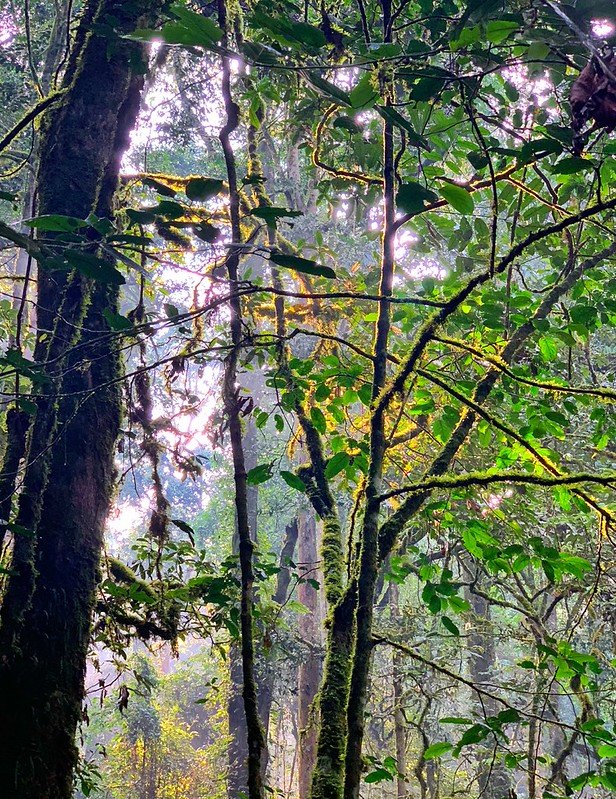
Waterfall Hiking Trails from the Forest of Hope Guest House
The waterfall hiking route is the one most people do on an arrival afternoon, and it sets the tone for the park. From the guesthouse the trail runs out across a tea plantation, a working one with pickers on the slopes, then crosses into forest along a river valley and finishes at a fall dropping through the trees.
Reckon on two to three hours at a relaxed pace with stops. Butterflies are everywhere in the open sections, and the tea to forest transition is where you get the clearest sense of what the whole area looked like before the trees came back and what it might look like again in twenty years.
Birders often walk this route slowly rather than treating it as a hike, since the edge habitat where plantation meets forest holds a different mix from either one on its own.
In the space of a single generation this forest went from a few hundred hectares of fragments to a functioning national park with a chimpanzee population inside it. Very few conservation stories move that fast.
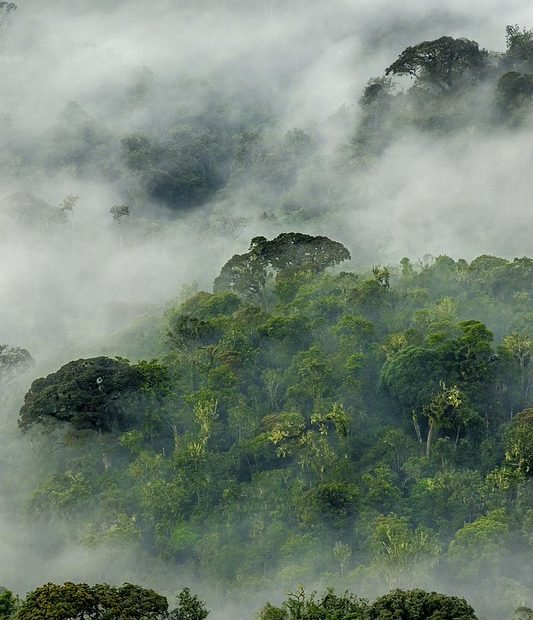
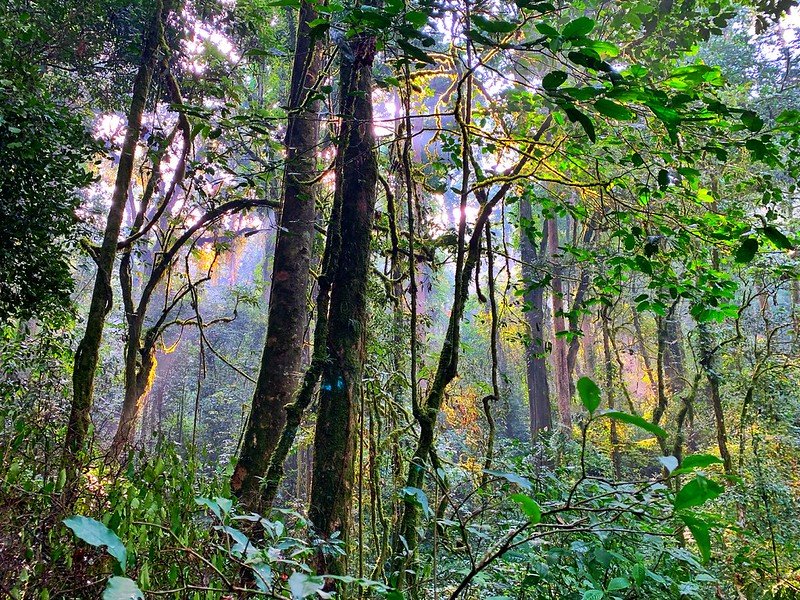
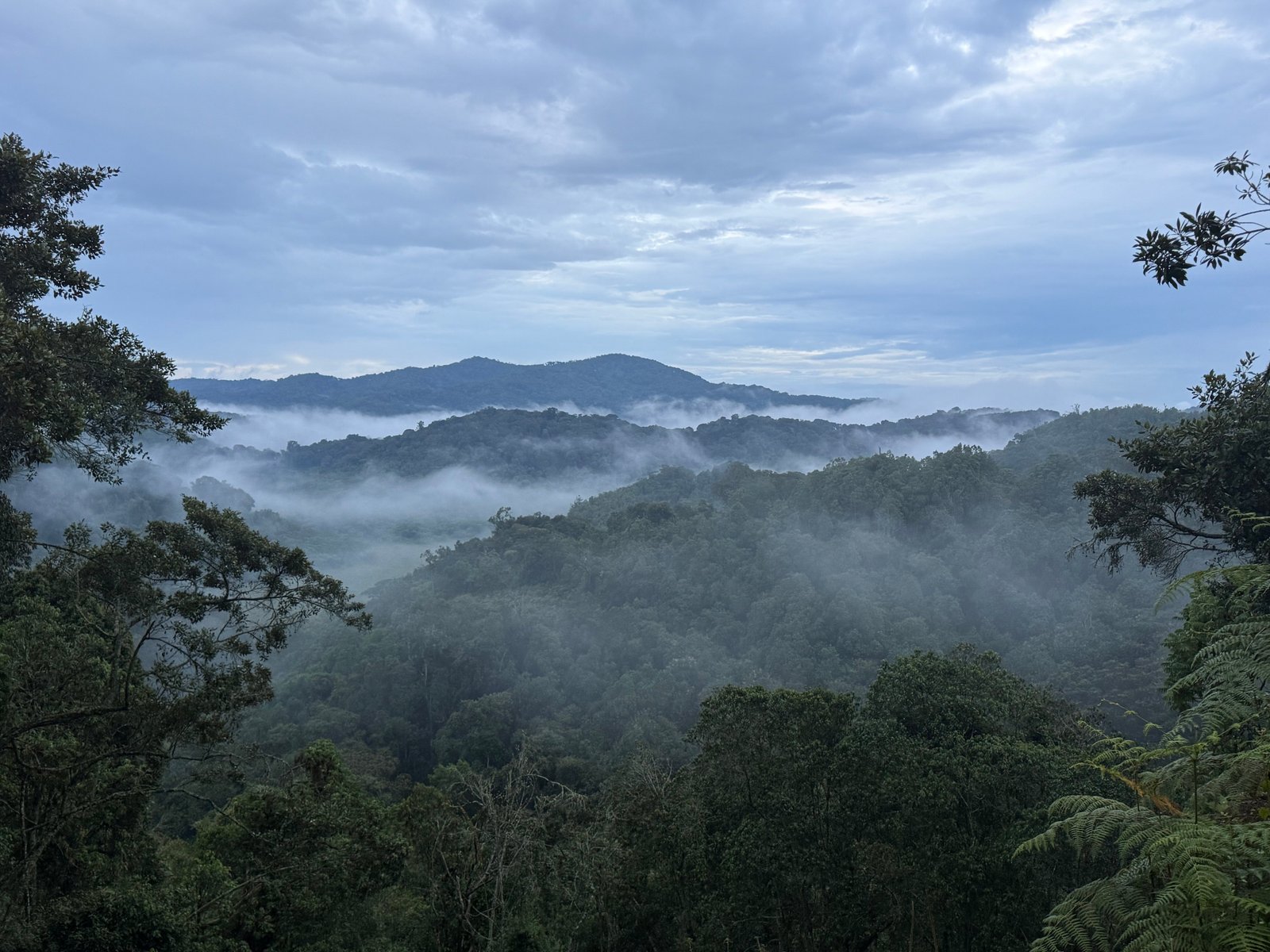
Photographed in Nyungwe Forest National Park. Gishwati Mukura National Park is the same Albertine Rift montane forest; no photography of the park itself is published.
Birding Safaris in the Gishwati and Mukura Forests
Birding safaris may be the strongest reason to come at all. Around 232 species have been recorded in the Gishwati block and roughly 163 in Mukura, with a solid list of Albertine Rift endemics among them, and the birding gets talked about far less than it deserves because so few people visit.
Targets include the Rwenzori turaco, regal sunbird, mountain yellow warbler, strange weaver, Rwenzori batis, grey crowned crane in the wetter margins and a range of forest specialists. The mix of restored forest, older growth, tea edge and open ridge means you work several habitats in one morning without much walking between them.
Mukura, the smaller of the two blocks, has no developed trails and remains largely closed to general visitors, though birders rate the forest highly and its records account for that separate species list. For now, practical birding means the Gishwati side.
Take binoculars and a guide who actually birds. Morning light on the eastern slopes is better than afternoon, and the ridge position means cloud often rolls in after midday.
Community Tours and the Forest of Hope Restoration Story
Tourism here is built around the surrounding communities rather than bolted onto them. The Forest of Hope Association leads the replanting and conservation work, the Rwanda Development Board oversees the park, and the guesthouse that hosts visitors is community owned, so the money from a stay goes into the villages on the boundary.
Community visits usually cover beekeeping cooperatives, several of them run by women’s groups, along with farming, craft work and the tea plantations that ring the forest. These are working operations rather than performances staged for arrivals, which is both the appeal and the reason they feel less polished than a cultural village elsewhere in Rwanda.
The restoration itself is the through line of any visit. Guides talk about which slopes were bare in their childhood, what was planted where, and how the buffer zone was negotiated with families who had been farming inside the boundary. That conversation is honestly the main thing you take away, more than any particular animal.
How Gishwati Mukura Compares to Rwanda’s Other Parks
It helps to know where this park sits against the other three before committing days to it, because the differences are larger than the map suggests.
Against Nyungwe. Nyungwe is thirty times larger, holds thirteen primate species and semi habituated chimp communities, and has the canopy walkway, the zipline and 130 kilometres of trail. Gishwati has one guesthouse, three trails and wary chimps. Nyungwe wins on certainty; Gishwati wins on solitude.
Against Volcanoes. No comparison on wildlife, since gorilla trekking is in a category of its own. Gishwati does share golden monkeys with the Virungas, and the two parks sit close enough on the western road that adding a night here costs little travel time.
Against Akagera. Completely different countries in effect. Akagera is warm, low and open with big game; Gishwati is cool, high and closed in with forest. They complement each other rather than competing, and travellers with ten days often take both.
Two nights is the realistic allocation. One night gives you a waterfall walk and an early morning attempt at the chimps, which is thin. Two lets you try the primates twice, walk Umushwati and Matyazo properly, spend a slow morning birding the tea edge and still fit a community visit.
Where to Stay for a Gishwati Mukura Safari
Accommodation is limited and that shapes how a visit works. The Forest of Hope Guest House at the old research station is the primary base, a small property with a handful of en suite rooms, hot water, power, and a balcony looking out over ridge after ridge of hills. A basic covered campsite sits alongside it for anyone carrying their own gear, with washrooms and a fire pit but no catering.
Park activities are arranged through the guesthouse rather than booked separately at a gate, and guided walks are available to guests staying there. Advance reservation is needed for both the rooms and the campsite, since capacity is genuinely small and there is no walk up option.
Some visitors base themselves instead at a lodge on the Lake Kivu shoreline near Rubavu or Karongi and come up for the day, which works for the waterfall walk and birding but rules out the pre dawn start that gives the best chimp odds. If the chimps are why you are coming, sleep in the park.
Best Time for a Gishwati Mukura Forest Trip
The climate here is cool and wet, sitting high on the Congo Nile divide where cloud gathers most afternoons. Rain is possible in any month and the forest would not exist without it.
June to September. The driest stretch and the best window for walking. Trails hold together, the ridge views open up, and the long climbs are far more pleasant. This is the period most visitors choose.
Mid December to February. A shorter dry period with similar conditions. Quiet, since the park sees few visitors at the best of times, and reasonable for both hiking and primate tracking.
March to May. Long rains. Trails turn heavy and the steeper sections get slow, though the waterfall runs hard and the forest is at its greenest. Chimps sometimes range lower during wet months.
October and November. Short rains, usually afternoon showers rather than all day weather. Good for birding as migrants move through, and mornings are often clear enough for the ridge trails.
Whatever the month, bring a waterproof, layers for cold evenings at altitude and boots with real grip. Nights on the ridge get properly cold once the sun drops behind the hills.
Getting to Gishwati Mukura National Park
The park sits in Rutsiro and Ngororero districts in the Western Province, roughly 150 to 160 kilometres from Kigali, which works out at about three to four hours by road. Most visitors do not come direct from the capital, though. The park sits neatly between the volcanoes in the north and Nyungwe in the south, on the road that follows Lake Kivu.
From Musanze and Volcanoes National Park the drive is around two and a half to three hours down the Kivu road. From Rubavu on the northern lakeshore it is closer to two hours. Heading on south, Nyungwe is another three to four hours, which makes Gishwati a natural stop rather than a detour if you are running the full western circuit.
The last stretch is dirt and climbs steeply, so a four wheel drive is the right vehicle, particularly in the wet months. There is no public transport worth relying on to the guesthouse itself, and the turnings are not obvious, so a driver who has been before saves a genuinely frustrating hour.
Gishwati Mukura rewards travellers who want somewhere quiet with a real story behind it, and it punishes anyone expecting a guaranteed primate photograph. Intare Safaris is Rwandan and runs the western circuit constantly, so they can tell you honestly whether this park suits your trip, how the chimps have been behaving lately, and how it fits between the volcanoes and Nyungwe without adding a wasted day.
Get in touch with Intare Safaris with your dates and what you are hoping for, and someone who has driven that ridge road will give you a straight answer rather than a sales pitch.